A team of researchers has developed a novel approach to address a critical vulnerability in AI-driven robotics: the inability of motion generators to distinguish between safe and unsafe actions based on environmental context. The work, detailed in recent research, tackles the challenge that identical robot movements can carry vastly different safety implications depending on what objects or people surround the machine.
Current safeguards for motion-generating systems typically rely on one of three strategies: examining the text instructions fed to the system, requiring large datasets of labeled motion examples, or imposing geometric constraints. According to arXiv, these existing methods fail to account for how scene context fundamentally changes the meaning and safety profile of a given motion.
The researchers introduced contextual safety filtering (CSF), a filter that operates without requiring any additional training of the underlying motion generator. The system works by grounding natural-language safety rules in reference trajectories that the motion generator already produces, distinguishing between safe and unsafe examples.
How It Works
For each active safety rule, the filter establishes an affine safety value using pairs of safe and unsafe reference trajectories. A control barrier function optimization program then enforces these safety constraints during execution, allowing the robot to make real-time adjustments that preserve safe behaviors while eliminating dangerous ones.
The team tested their approach across four different pretrained motion generators with varying architectures. The results demonstrated consistent activation of safety rules across both explicitly unsafe cases and scenarios where danger emerged from scene context. Most significantly, the filtering reduced dangerous events by as much as 90% while preserving 88 to 100% of benign motions that should have proceeded normally.
Real-World Validation
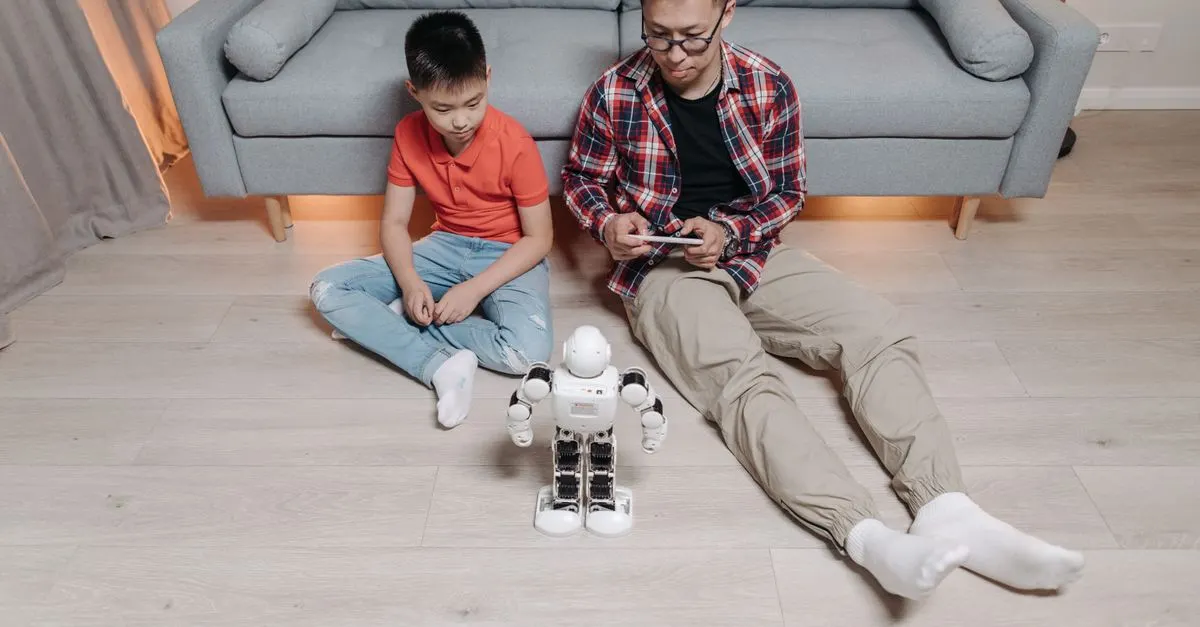
Beyond simulation testing, researchers deployed the complete system on a Unitree G1 humanoid robot to validate performance in physical environments. The robot successfully avoided unsafe motions across multiple real-world scenarios, including interactions with human operators and manipulation of objects.
The practical impact of this work extends across applications where robots must operate near people or sensitive environments. Manufacturing settings, healthcare facilities, and collaborative workspaces all stand to benefit from motion generation systems that understand environmental nuance.
Key Advantages
- Training-free implementation that works with existing pretrained models
- Dramatic reduction in dangerous events without sacrificing normal task completion
- Context-aware safety that understands how scenes change action meanings
- Demonstrated effectiveness across different generator architectures
- Real-world tested on physical robotic systems
The research addresses a growing concern in robotics and AI safety: as motion generation systems become more capable and are deployed in real environments, their safety mechanisms must evolve beyond simple rule-checking to truly understand context. This work represents a meaningful step toward robots that can operate safely alongside humans while maintaining the flexibility to perform complex, dynamic tasks.